
EP2: The Productivity Paradox - Why Measuring Engineering Performance Is So Challenging
Engineering Operations - How to create a culture of engineering operation auto-pilot?

Engineering productivity is a critical concern for technology organizations, yet measuring it effectively remains one of the most challenging aspects of engineering management. This post explores the fundamental paradox at the heart of engineering productivity measurement and why simplistic approaches often fail.
The Multidimensional Nature of Engineering Work
Engineering work is inherently multidimensional, involving creative problem-solving, technical execution, collaboration, and continuous learning. Unlike manufacturing processes where output can be measured in units produced, engineering productivity encompasses both quantitative and qualitative dimensions:
Output: Code written, features delivered, bugs fixed
Quality: Reliability, maintainability, security of solutions
Impact: Business value created, customer problems solved
Growth: Knowledge acquisition, skill development
Collaboration: Knowledge sharing, mentoring, team effectiveness
This multidimensional nature makes it impossible to capture engineering productivity in a single metric. Organizations that attempt to do so inevitably end up optimizing for one dimension at the expense of others. Sometimes leading to very low morale and irreversible culture changes.
The Observer Effect in Engineering Measurement
One of the most challenging aspects of measuring engineering productivity is what physicists call the "observer effect" - the act of measurement itself changes what's being measured. When engineers know they're being measured on specific metrics, their behavior naturally shifts to optimize for those metrics, often in ways that don't align with organizational goals.
For example, if engineers are measured primarily on lines of code written, they may produce verbose, inefficient code. If measured on number of tickets closed, they might prioritize easy tasks over important ones. If measured on story points completed, they might inflate estimates.
This observer effect is particularly strong in knowledge work like engineering, where workers have significant autonomy in how they approach problems. The very act of selecting metrics signals what the organization values, inevitably influencing behavior.
When thinking about engineering productivity measurement metrics, I like to frame it in terms of SPACE, a widely used industry framework. However, the real challenge lies in balancing and prioritizing metrics based on the team’s stage, rather than trying to measure everything at once.
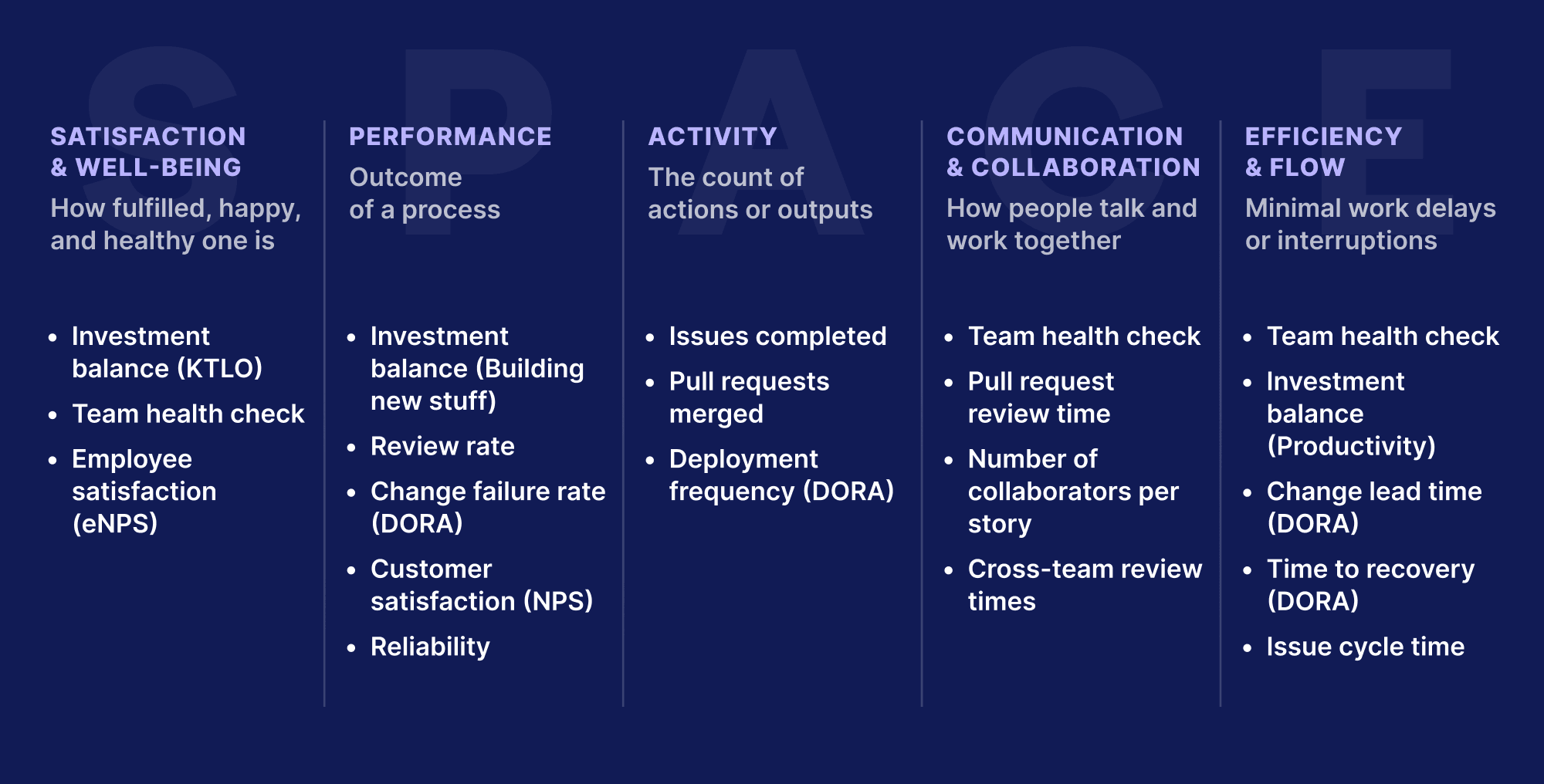
The SPACE framework provides a multidimensional approach to measuring engineering productivity, addressing the limitations of single-metric approaches.
The Productivity Measurement Matrix
To understand the challenges of engineering productivity measurement, consider this matrix of measurement approaches:
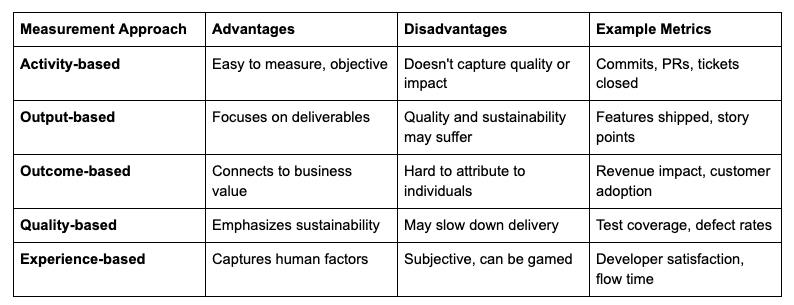
No single measurement approach provides a complete view of engineering productivity. While activity-based metrics are easy to track, they often miss the quality and impact of the work. Output-based and outcome-based metrics better align with business goals, but they can be difficult to attribute at an individual level. Meanwhile, quality-based metrics ensure long-term sustainability, though they may introduce trade-offs in speed. Experience-based metrics help assess developer well-being but can be subjective and prone to manipulation.
How to solve this, I will share my two cents later in the post.
The Productivity Perception Gap
Another challenge in measuring engineering productivity is the gap between perceived and actual productivity. Engineers often feel most productive when they're in a state of flow, writing code without interruptions. However, from an organizational perspective, productivity might be better measured by the impact of that code on business outcomes.
This perception gap leads to situations where:
Engineers feel productive but aren't delivering business value
Engineers feel unproductive (in meetings, helping others) but are actually enabling team productivity
Management implements "productivity initiatives" that engineers experience as counterproductive
Bridging this gap requires shared understanding and alignment on what productivity means at different levels of the organization.
The Productivity Paradox in Practice
The productivity paradox manifests in several common scenarios in engineering organizations:
Scenario 1: The Velocity Trap
A team focuses intensely on increasing velocity (story points per sprint), successfully doubling their "productivity" over six months. However, technical debt accumulates, leading to increasing bugs and slower feature development in subsequent quarters. The short-term productivity gain leads to long-term productivity loss.
Scenario 2: The Quality Quagmire
A team prioritizes code quality above all, implementing extensive testing and review processes. Code quality metrics improve dramatically, but delivery slows to a crawl. The business loses market opportunities due to slow time-to-market, despite having "high-quality" code.
Scenario 3: The Collaboration Conundrum
A senior engineer spends significant time mentoring junior team members, reviewing code, and helping unblock others. Their personal output metrics decline, leading to concerns about their productivity, despite the fact that they're significantly enhancing team productivity.
These scenarios illustrate why simplistic approaches to productivity measurement inevitably fail to capture the complex reality of engineering work.
Principles for Effective Productivity Measurement
Given these challenges, how should organizations approach engineering productivity measurement?
A Weighted Approach to Productivity Measurement
Rather than relying on a one-size-fits-all model, the most effective systems use a weighted combination of these approaches, adjusting priorities based on team goals, project phases, and business needs. For example:
In an early-stage startup, output and outcome-based metrics may take priority to ensure fast iteration and market fit.
In a mature engineering organization, quality and experience-based metrics become more critical to maintain system stability and developer retention.
For infrastructure and platform teams, quality and outcome-based metrics often outweigh raw output.
Avoiding the Pitfalls of Misaligned Metrics
Poorly designed measurement systems can incentivize the wrong behaviors. Overemphasizing activity-based metrics can lead to shallow productivity, where engineers optimize for volume over value. Similarly, relying too much on output-based metrics can encourage teams to ship fast but accumulate technical debt.
By applying a balanced, evolving measurement strategy, teams can ensure that engineering productivity aligns with long-term success, rather than just short-term performance.
Several principles can guide more effective approaches:
Measure multiple dimensions and embrace changes: Use a framework like SPACE (Satisfaction, Performance, Activity, Communication, Efficiency) to capture different aspects of productivity and change based on stage and organization needs.
Balance leading and lagging indicators: Include both process metrics (leading) and outcome metrics (lagging) to get a complete picture.
Consider team productivity over individual productivity: Focus primarily on team-level metrics, as engineering is fundamentally collaborative.
Incorporate qualitative and quantitative data: Complement quantitative metrics with qualitative insights from surveys, retrospectives, and conversations.
Adapt metrics to context: Different teams, projects, and phases require different metrics; avoid one-size-fits-all approaches.
Use metrics for learning, not evaluation: Frame metrics as tools for improvement rather than performance evaluation to reduce gaming and anxiety.
Involve engineers in metric selection: Engineers should participate in defining how their work will be measured to ensure buy-in and relevance.
Embracing the Paradox
The productivity paradox in engineering isn't a problem to be solved but a tension to be managed. By acknowledging the inherent complexity of engineering work and the limitations of any measurement approach, organizations can develop more nuanced, effective ways to understand and improve engineering productivity.
In the next post, we'll explore how Goodhart's Law affects engineering metrics and why "when a measure becomes a target, it ceases to be a good measure."